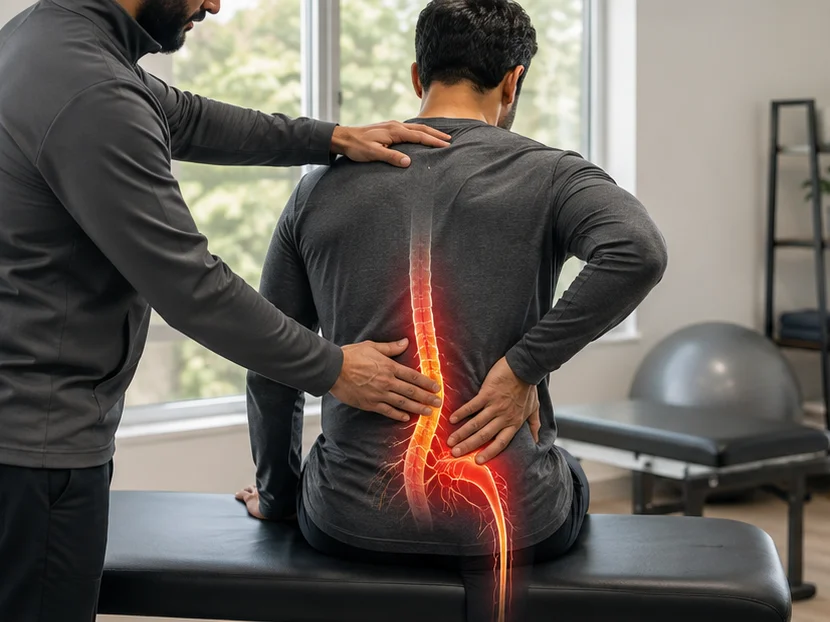

Sciatica rarely stays where it starts. It begins as a dull ache in the lower back and, within days, travels through the buttock, down the back of the thigh, and sometimes all the way to the calf or foot. If you’re searching for sciatica physiotherapy exercises, you’ve likely already tried resting it out — and found that rest alone doesn’t fix it.
That instinct to move rather than freeze is actually backed by research. A randomized controlled trial published in the Annals of Internal Medicine followed 220 adults with recent-onset sciatica and found that those referred early to physical therapy — a program built around exercise and manual therapy — reported meaningfully better function and pain outcomes than those who took a standard wait-and-see approach. The takeaway for anyone dealing with sciatic nerve pain: the right movement, done early and consistently, is treatment, not just symptom management.
This guide covers what sciatica actually is, which sciatic nerve physiotherapy exercises are worth trying at home, which sciatica physio stretches deserve caution, and how to turn scattered stretching into a real sciatica PT routine.
What Is Sciatica, Exactly?
Sciatica is nerve pain, not a diagnosis in itself. It happens when the sciatic nerve — the longest nerve in the body, running from the lower back through the buttock and down each leg — gets compressed or irritated. According to the Mayo Clinic, the most common cause is a herniated disc or a bone spur pressing on a lumbar nerve root, though tight muscles (like the piriformis) can mimic the same symptoms. The Cleveland Clinic notes that true sciatica and “sciatica-like” pain from nearby nerves often feel identical to the person experiencing them, which is exactly why a proper physiotherapy assessment — not guesswork — matters before you commit to a routine.
At HEAL Rehab Centre, sciatica is one of the low back conditions we see regularly in Mangaluru, and it’s listed as a dedicated option (“Slip Disc / Sciatica”) on our appointment form, because the exercises that help depend entirely on what’s driving the compression.
Why Physiotherapy Exercises Work for Sciatica — With an Honest Caveat
Beyond the Annals of Internal Medicine trial mentioned above, a 2023 systematic review and meta-analysis in the European Spine Journal, which pooled 18 trials and nearly 2,700 participants, confirmed that physiotherapy is widely used as first-line sciatica treatment. But it also found the underlying studies were highly inconsistent in quality and method, and stopped short of naming one single “best” protocol for everyone. That’s an important, honest caveat: there is no universal sciatic nerve physiotherapy exercise that works the same way for every person, because sciatica itself has different root causes.
This is also why the UK’s NICE guideline on low back pain and sciatica recommends exercise and movement as a core treatment but explicitly leaves the type of exercise to be matched to the individual, rather than prescribing one fixed stretch routine nationally.
The Directional Preference Principle
Many physiotherapists use a framework (often called the McKenzie method, or mechanical diagnosis and therapy) where a clinician tests which direction of spinal movement — bending forward or arching back — reduces or “centralizes” your leg pain. Get the direction right, and stretches accelerate recovery. Get it backward, and the same stretch can push symptoms further down the leg. This is the single biggest reason generic “sciatica stretch” lists found online can help one person and worsen another’s symptoms.
Safety First: When to See a Doctor Before You Stretch
Most sciatica is manageable with conservative care, but a small number of cases are medical emergencies. The Cleveland Clinic is clear that new numbness in the groin or inner thighs (“saddle” numbness), loss of bladder or bowel control, or rapidly worsening leg weakness can signal cauda equina syndrome — a rare but urgent condition requiring same-day medical evaluation, not home exercises. If any of these apply to you, skip the stretches below and seek emergency care first.
Why “Just Follow a YouTube Video” Often Backfires
At HEAL Rehab Centre, a pattern we see often is someone who develops sciatic pain, finds a stretching video or reel online, and follows it on their own for days or weeks. Many only book an appointment once the pain has spread further down the leg or become harder to manage — not because exercise was the wrong idea, but because the exercises they picked were never matched to their specific case.
This is the core reason we don’t hand out a generic stretch sheet before an assessment. Exercise for sciatica isn’t one-size-fits-all: the right program depends on your specific condition, your current strength, any muscle imbalances, your movement patterns, and your neuromuscular control. Two people can describe identical symptoms — pain shooting down the back of the leg — and need opposite exercises, because one is dealing with a disc-related nerve root issue that responds to extension, while the other has a movement pattern or muscle imbalance that flexion-based stretches would actually aggravate. A video can’t test your directional preference, spot which muscles are compensating, or catch a movement habit that’s quietly overloading the wrong structure. A physiotherapist can.
7 Sciatica Physiotherapy Exercises Physios Commonly Recommend
The following are exercises frequently used in sciatica PT routines. They are general education, not a substitute for an individual assessment. As above, the right exercise for one person’s sciatica may not be the right one for another — a physiotherapist should confirm which of these suit your specific condition, strength, and movement pattern before you make them a daily habit.
- Pelvic tilts — Lie on your back, knees bent, feet flat. Gently flatten your lower back into the floor by tightening your abdominals, hold five seconds, release. This builds core control that supports the lumbar spine during the rest of your routine.
- Knee-to-chest stretch — Lying on your back, pull one knee toward your chest and hold 20–30 seconds. This is a flexion-based stretch that some people with sciatica find relieving and others find aggravating — which is exactly the directional-preference issue discussed above.
- Reclining piriformis stretch — Lying on your back, cross the affected ankle over the opposite knee and gently pull the lower thigh toward your chest. This targets the piriformis muscle, which sits close to the sciatic nerve and can compress it when tight.
- Seated piriformis stretch — Sitting in a chair, cross the painful-side ankle over the opposite knee and lean forward from the hips with a straight back until you feel a stretch in the buttock.
- Standing hamstring stretch — With one heel on a low step or chair, keep the leg straight and hinge forward from the hips. Tight hamstrings can increase tension along the same pathway as the sciatic nerve.
- Sciatic nerve glides (“nerve flossing”) — A gentle, controlled movement of the leg and ankle designed to mobilize the nerve without stretching it aggressively. A 2024 clinical trial in PMC found that adding gentle sciatic nerve glides to a conventional exercise program improved pain scores more than conventional exercise alone — this is typically taught and supervised by a physiotherapist rather than self-started.
- Cat-cow stretch — On hands and knees, alternate arching and rounding your back slowly. This is a general mobility exercise many people tolerate well as a warm-up before more targeted stretches.
Sciatica Stretches to Approach with Caution
Not every popular “sciatica stretch” belongs in every routine:
- Aggressive, forced deep glute or pigeon-pose stretches during an acute flare can irritate an already sensitive nerve rather than calm it.
- Heavy loaded hip work or ballistic (bouncy) stretching is generally discouraged while symptoms are irritable.
- Any stretch that sends pain further down the leg (past the knee, toward the foot) rather than closer to the spine should be stopped immediately — this “peripheralization” is a sign the movement direction is wrong for you, not that you need to push through it.
If a stretch consistently makes your leg symptoms worse rather than better, that’s useful diagnostic information — bring it to your physiotherapist rather than persisting with it.
Building a Sciatica PT Routine That Actually Sticks
A single stretch done once won’t undo weeks of nerve irritation. What tends to work, based on the research above, is a short, consistent routine — often two to three focused sessions a day of a small number of exercises matched to your directional preference — sustained over several weeks, alongside staying as active as your symptoms allow. This is also the structure behind our own approach: every patient at HEAL Rehab Centre begins with a comprehensive evaluation, because prescribing a generic sciatica physio stretch list without first identifying whether flexion or extension helps you is exactly the mismatch the European Spine Journal review flagged as a weakness in lower-quality care.
Our treatments are built around this same evidence-based, individualized philosophy — orthopedic and neurological rehabilitation programs that adjust as your symptoms change, rather than a fixed printed handout.
Real Recovery, Real Patients
While the case studies below aren’t sciatica-specific, they reflect the same rehabilitation philosophy we apply to every condition we treat, including sciatica. Zahan PC came to us recovering from a torn PCL and described the facilities, doctors, and staff as central to getting back to walking normally. M Vignesh began physiotherapy with us before ACL surgery and continued through recovery, crediting the consistency and support of the sessions for keeping him motivated. The same structured, personalized approach — assessment first, then a plan that’s adjusted as you improve — is what we apply to sciatica and slip disc cases as well.
When to See a Physiotherapist for Sciatica in Mangaluru
Home exercises are a reasonable starting point for mild, recent-onset sciatica. But you should book a physiotherapy assessment rather than continuing to self-treat if:
- Pain has lasted more than a week or two without improvement
- You’re not sure whether flexion or extension stretches help or hurt your specific symptoms
- Symptoms are getting worse rather than better
- You’ve read conflicting advice online and don’t know which sciatica pt exercises actually apply to your case
You can book an appointment with HEAL Rehab Centre directly, or call +91 8281 715 795. We’re open Monday to Saturday, 9:30 am to 5 pm.
Frequently Asked Questions
1. Can physiotherapy really treat sciatica, or will I eventually need surgery?
For most people, sciatica improves with conservative care. The Mayo Clinic notes that most people recover fully from disc-related sciatica, often within weeks to months, and that surgery is generally reserved for severe weakness, loss of bladder or bowel control, or pain that hasn’t responded to other treatment.
2. How long does a sciatica physiotherapy exercise routine take to show results?
This varies by cause and severity. In the Annals of Internal Medicine trial referenced above, patients were followed over a 4-week active physical therapy program, with outcomes measured up to a year later — consistency over weeks, not days, is the realistic timeline.
3. What sciatica exercises should I avoid?
Avoid forced, deep stretches during a flare-up, ballistic or bouncy stretching, and any movement that sends pain further down your leg rather than closer to your spine.
4. Is walking okay with sciatica?
Generally yes. Staying appropriately active is consistently recommended over bed rest across the sources referenced in this guide; the specific amount and pace should be guided by what your symptoms tolerate.
5. Does HEAL Rehab Centre treat sciatica in Mangaluru?
Yes. Sciatica (listed as “Slip Disc / Sciatica”) is one of the conditions we assess and treat, alongside low back pain, herniated discs, and related neurological and orthopedic conditions.
6. When should I see a doctor instead of starting exercises at home?
Seek immediate medical attention if you notice numbness in the groin or inner thighs, loss of bladder or bowel control, or rapidly worsening leg weakness — these can indicate a medical emergency and are not appropriate to self-treat with stretches.
This article is for general education and does not replace an individual physiotherapy assessment. If you’re in Mangaluru and dealing with sciatic nerve pain, get in touch with HEAL Rehab Centre to have your specific symptoms evaluated.